Project logic
Problem, system, output.
VacancyQL treats job discovery as an evidence problem. Official source identity, collection completeness, vacancy history, matching evidence, and the final human decision stay connected instead of being flattened into another job-board score.
High-value roles are scattered across official career sites.
Broad aggregators make discovery convenient but can obscure source provenance, material changes, and the evidence behind a recommendation.
Operational truth is separated from personal intelligence.
Reviewed connectors preserve official observations and conservative lifecycle state before deterministic matching produces a reviewable outcome.
The final decision remains visible and human-owned.
The private workspace joins evidence, uncertainty, review state, next action, and application progress without submitting anything to an employer.
Pipeline
From source inputs to reviewed output.
- Registry
Reviewed source
Each employer is bound to one configured official ATS identity.
- Collect
Complete observation
Provider-aware connectors preserve source identity and completeness evidence.
- Truth
Lifecycle state
Discoveries, material updates, absences, closures, and reopenings remain traceable.
- Evaluate
Deterministic match
Versioned rules produce relevant, review-required, or not-relevant outcomes.
- Review
Human decision
Evidence, gaps, notes, next action, and application stage share one workspace.
- Operate
Safe automation
Due clocks, leases, completeness guards, backups, and cost limits bound unattended work.
Artifact proof
Two public-safe specimens.
Synthetic examples only. No private source material is shown.
Lifecycle guard
Synthetic source-result decision table
A missing role is not enough to close it. Only complete successful observations can contribute qualifying absence evidence.
| Source result | Lifecycle effect | Reason |
|---|---|---|
| Complete success · role present | Keep live | Current source evidence exists |
| Complete success · first absence | Suspected closure | One qualifying absence |
| Failed or incomplete result | Preserve state | Cannot contribute closure evidence |
| Third qualifying absence | Close | Conservative threshold reached |
Matching states
Three honest outcomes
The system does not collapse uncertainty into a probability. Ambiguous evidence remains visible for review.
- RelevantEvidence-backed
Responsibility evidence aligns with the reviewed profile
- Review requiredUncertainty preserved
The available evidence does not justify a confident decision
- Not relevantClear boundary
Eligibility or evidence fails the deterministic rules
- Exact-currentNo stale result
Material vacancy changes withhold old evaluations
Product evidence
Two public-safe product views.
Fictional demonstration data only. The public presentation has no production connection or outbound source access.
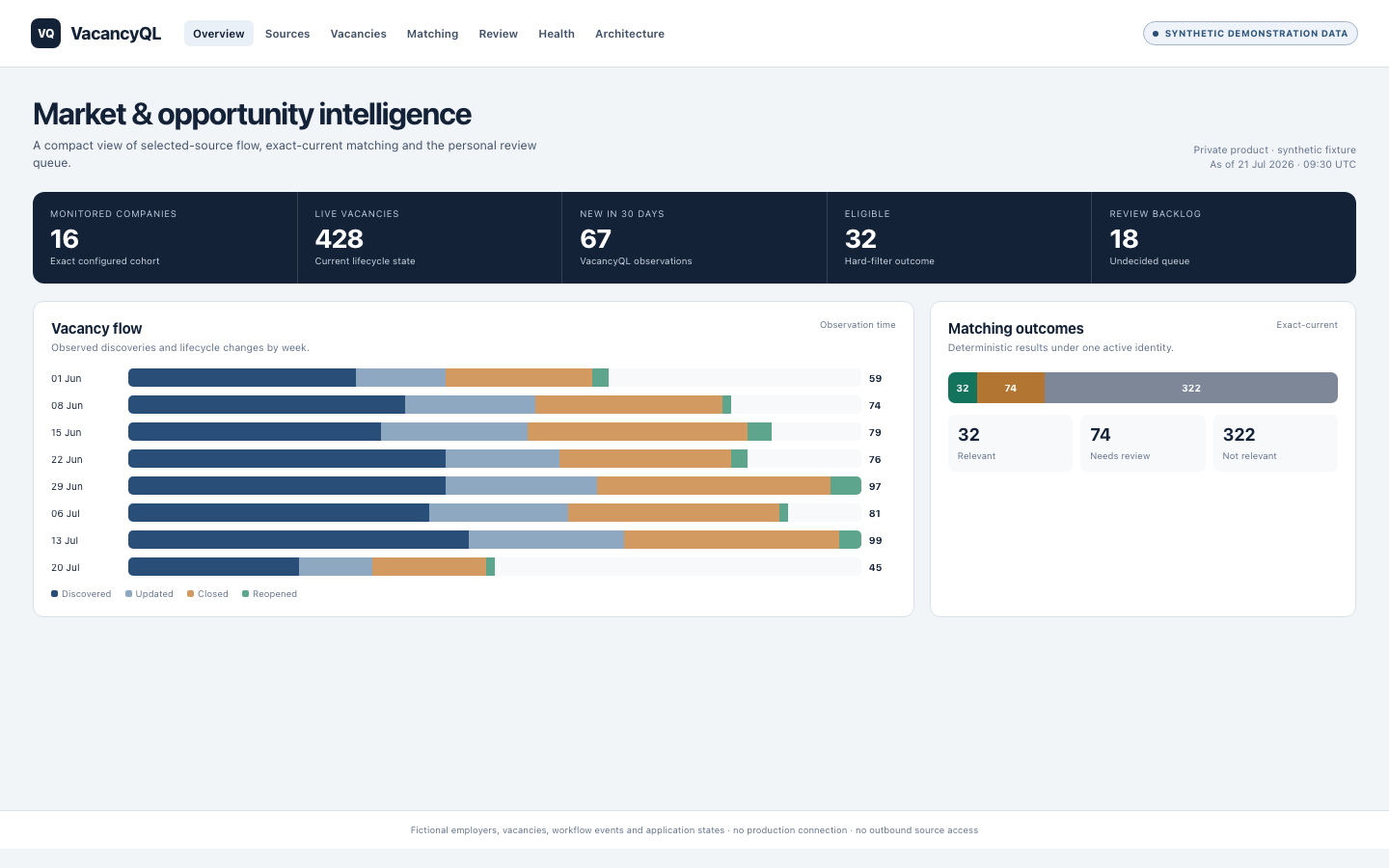
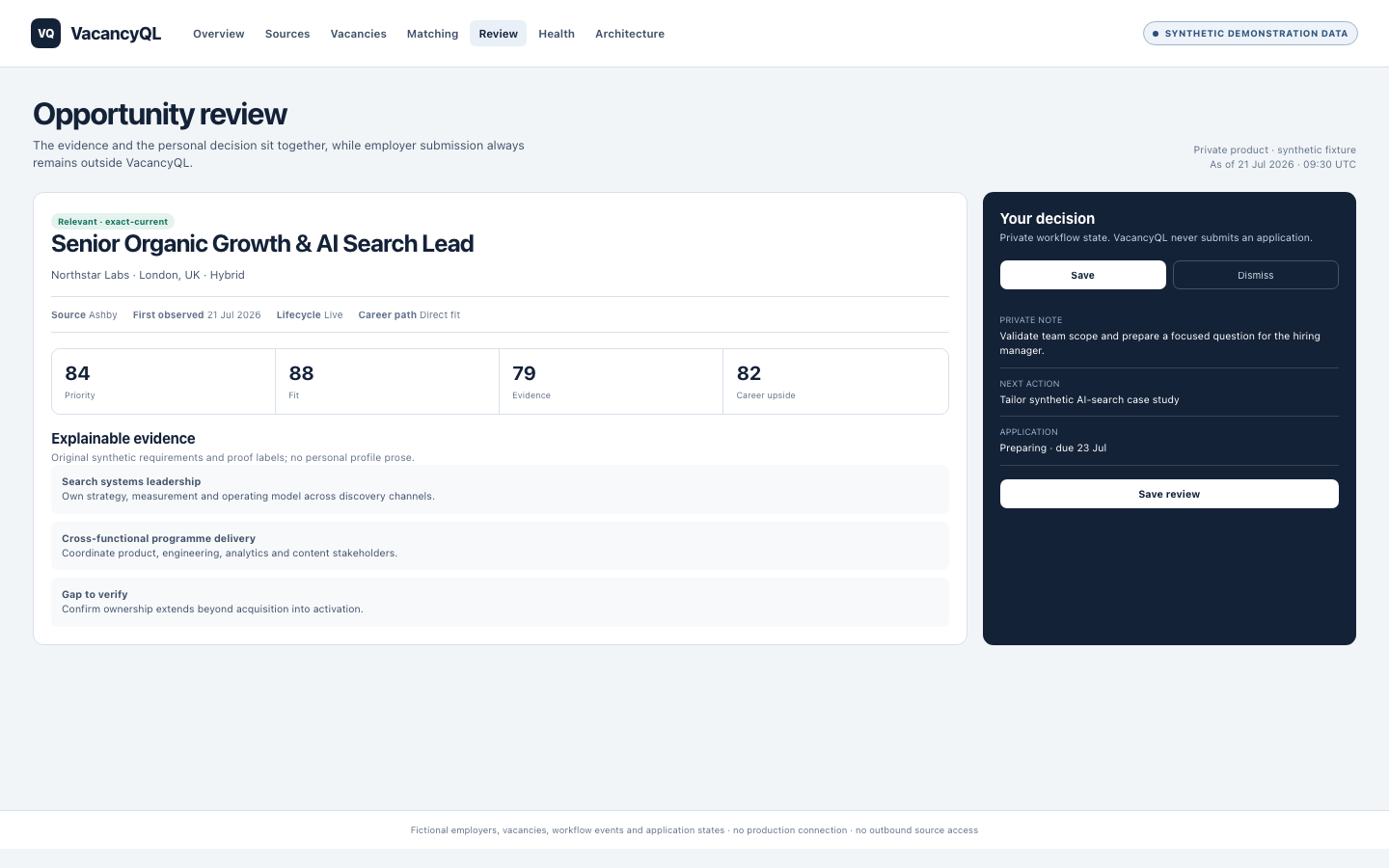
Mini representation
Test the lifecycle guard
Choose a synthetic source result and prior absence count to see whether the vacancy stays live, enters suspected closure, or closes.
- Lifecycle state
- Live
- Absence evidence
- No qualifying absence
- Next action
- Keep the vacancy available for review
Simplified portfolio representation. Synthetic values only; no production vacancy or source data.
Governance / QA
The most important product behaviour is restraint
VacancyQL is useful because it knows what it is not allowed to infer. Source failures do not become closures, keywords do not become probabilities, and automation does not become an employer submission.
- Failed and incomplete source results cannot advance closure.
- Material vacancy changes withhold stale evaluations until reevaluation.
- Review-required is a first-class state rather than a hidden scoring failure.
- Application submission always remains outside the product.
What this demonstrates
- End-to-end product and systems thinking.
- Source provenance and change detection.
- Deterministic, explainable decision logic.
- Privacy and least-privilege design.
- Safe unattended automation.
- Turning a real-world job-search problem into a working product.
Next iterations
- Collect more representative reviewed positive examples before recalibrating matching.
- Expand source coverage only through the existing reviewed-registry process.
- Continue refining the private review experience around real use.
- Keep the public demo synthetic and separate from production.